Starting a newspaper, magazine, or publication in India is an exciting entrepreneurial journey. However, before you print your first copy, navigating the legal framework is absolutely essential. The most critical step for any print media business is securing an RNI (Registrar of Newspapers for India) or PRGI (Press Registrar General of India) registration.
If you are confused by the complex legalities and paperwork, this guide will help you understand the basics and show you how to get expert assistance for a fast, hassle-free registration.
Why is PRGI / RNI Registration Mandatory?
Getting your publication registered is more than just a government rule; it provides the solid foundation your media business needs to grow. Here is why PRGI registration is absolutely non-negotiable for serious publishers:
-
Complete Legal Validity: It officially registers your media house with the Ministry of Information and Broadcasting (MIB) . Without it, you are not a legally recognized publisher.
-
Brand Title Protection: Once your title is verified, no one else in India can legally use your publication’s name. This is your biggest brand asset.
-
Government Ad Eligibility: Only registered publications can apply for government advertising tenders (DAVP empanelment) , which is a major revenue source for newspapers and magazines.
-
Public Trust: An official registration number immediately boosts your credibility among readers, journalists, and advertisers.
-
Press Accreditation: Your journalists can apply for official Press Cards, railway passes, and other government facilities only after registration.
-
Legal Protection: Registered publishers get legal protection under the PRP Act 2023, safeguarding your publication from infringement and unauthorized use.
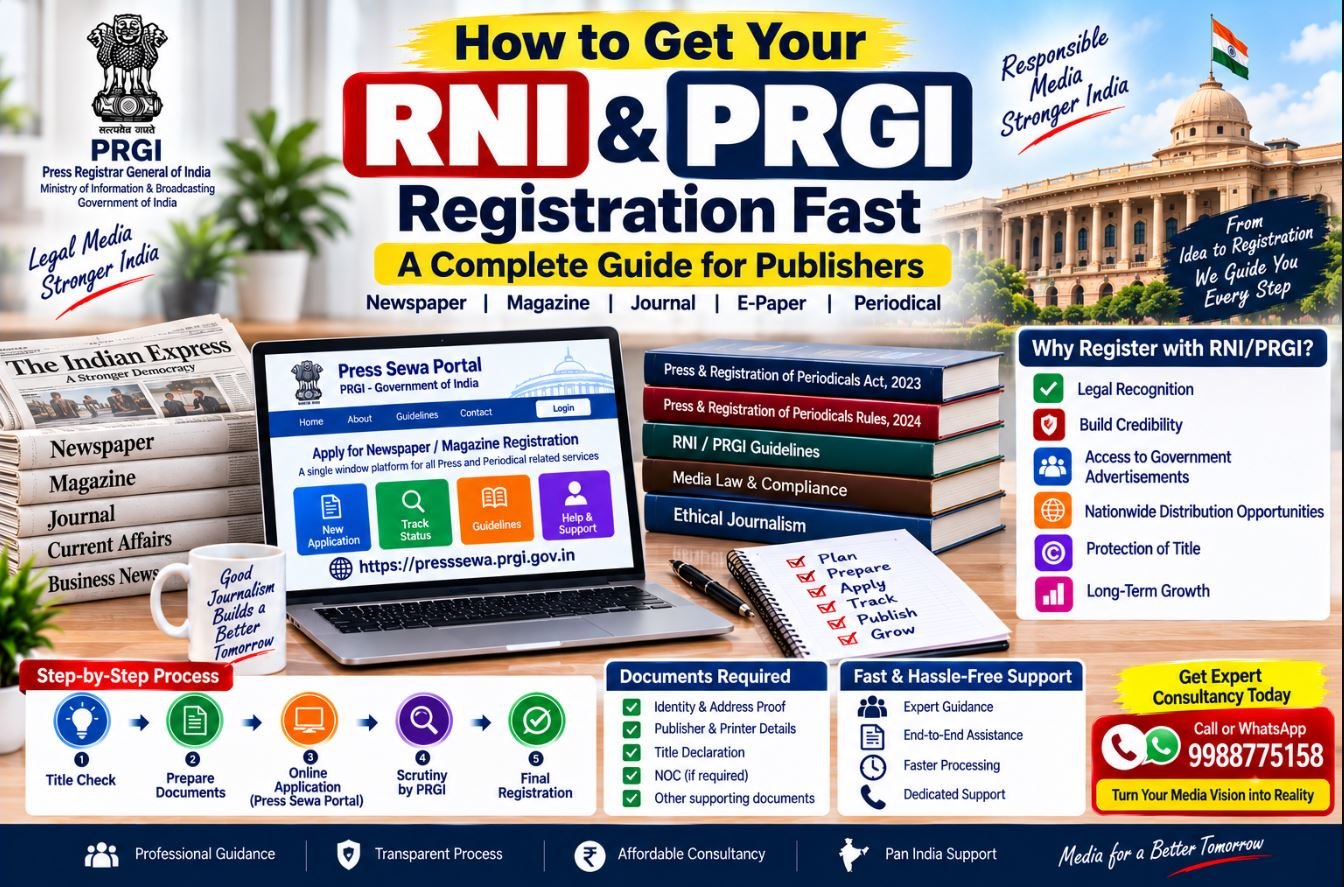
The Standard Registration Process
The PRGI registration process involves several strict deadlines and precise documentation. A single mistake can lead to your application being rejected, which can delay your project by months. Here is the step-by-step process:
Step 1: Title Verification
Applying for a unique publication name through your local District Magistrate (DM) . You must submit 5 priority options for your publication’s name. The PRGI algorithm checks for phonetic similarity, reserved words, and trademark conflicts. This is the most critical step — 60% of applications fail here.
Step 2: Authentication of Declaration
Filing the correct affidavits and legal forms with the authorities. This includes the Form-I Declaration, Eligibility and Content Affidavit, and Printer’s Certificate (Form-IV) . Every document must follow the exact format prescribed under the PRP Act 2023.
Step 3: First Issue Publication
Designing and printing your very first issue within the government’s strict timeframe. For dailies, you have 45 days; for periodicals, 90 days. The Imprint Line must be 100% accurate — even a single missing comma can cause rejection.
Step 4: Final Submission
Sending the final printed copies and verified documents to the main PRGI office in New Delhi for your official certificate. After verification, you can download your Certificate of Registration (CoR) directly from the Press Sewa Portal.
Documents Required for RNI & PRGI Registration
To ensure a fast PRGI registration, keep this documents checklist ready:
-
Aadhaar Card and PAN Card of the Publisher and Owner
-
Passport-size photographs
-
Rent Agreement or Electricity Bill of the publication office
-
Printer Certificate Form-IV from the printing press
-
Keeper of the Press Agreement with the printer
-
Eligibility and Content Affidavit
-
Form-I Declaration signed by Publisher and Printer
-
For companies: Certificate of Incorporation, CIN, Board Resolution
Common Reasons for PRGI Application Rejection
-
Title Rejection: Similar phonetic name, reserved words, or trademark conflict.
-
Document Errors: Wrong affidavit format, incomplete Form-I declaration, missing printer certificate.
-
Incorrect Imprint Line: Even a single missing comma or mismatch can cause rejection.
-
Technical Issues: Aadhaar/mobile linking errors, file upload failures on the portal.
-
Outdated Formats: Using old affidavit formats from before the PRP Act 2023.
Simplify the Process with Expert Consultancy
Filing for media registration can be overwhelming, time-consuming, and highly technical. That is where we step in.
At PRGI Registration Consultancy, we provide complete, end-to-end assistance for all your RNI and PRGI registration needs. From initial title verification to securing your final certificate, our experts ensure a smooth, hassle-free, and guaranteed process. We serve clients across all of India, helping journalists and publishers focus on their news while we handle the legal paperwork.
Why Choose PRGI Registration Consultancy?
-
Pan-India Service: From Delhi NCR, Bihar, UP, Rajasthan, Maharashtra to Bangalore, Chennai, Hyderabad, and Kochi — wherever you are, we get your work done.
-
First-Time Approval: We prepare your documents, name options, and affidavits with such precision that the risk of rejection is reduced by 99% .
-
Printer Arrangement: If you don’t have a printer, we connect you with verified printing presses.
-
Time Saving: DM office visits, follow-up calls, portal technical errors — we handle all the headaches.
-
End-to-End Support: From thinking of a title to getting the final certificate in your hands, our team stands with you at every step.
-
Affordable & Transparent: No hidden charges, everything is clearly communicated upfront.
Frequently Asked Questions (FAQs)
Q1: How long does RNI/PRGI registration take?
A: If all documents are correct, the process typically takes 2 to 4 months from title submission to final certificate. Objections can extend this to 6+ months.
Q2: What is the PRGI registration fee?
A: The mandatory government fee is ₹1,000 (non-refundable). Professional consultancy charges range from ₹15,000 to ₹35,000 depending on the package you choose.
Q3: Can I register a publication without owning a printing press?
A: Yes, you can. You must have a Keeper of the Press Agreement with a registered commercial printer who has an active profile on the Press Sewa Portal.
Q4: What is the difference between RNI and PRGI?
A: RNI (Registrar of Newspapers for India) was the old authority. Under the PRP Act 2023, it was renamed PRGI (Press Registrar General of India) . The registration process is now completely digital via the Press Sewa Portal.
Q5: Can I do PRGI registration myself without a consultant?
A: Yes, but the risk of rejection is very high. Technical errors, wrong affidavit formats, or title conflicts can delay your project by months. A consultant ensures first-time-right filing.
Q6: What documents are required for PRGI registration?
A: Key documents include: Aadhaar Card, PAN Card, address proof, Eligibility and Content Affidavit, printer details, and Form-I Declaration. For companies, a Certificate of Incorporation is also required.
Q7: What is the Imprint Line and why is it important?
A: The Imprint Line is the footer on the last page of your publication that legally declares the Printer, Publisher, Owner, and Editor’s details. Under the PRP Act, this must follow a strict format. Any deviation can cause your final certificate to be rejected.
Q8: How can I check my RNI/PRGI application status?
A: You can track your application in real-time through the dashboard on the Press Sewa Portal. You can also use the RNI status check online feature.
Q9: Is the registration process the same for magazines and newspapers?
A: Yes, the magazine registration process in India and newspaper registration are almost identical. The only difference is the frequency of publication (daily, weekly, monthly).
Q10: Can I get government advertisements after RNI registration?
A: Yes, after registration, you can apply for government advertisements under DAVP (now CBC) , which can become a major source of revenue for your publication.
Start Your Publication Journey Today!
Do not let complex legal paperwork delay your dream project. Contact India’s trusted registration experts today.
🌐 Visit our website: https://prgiregistration.com/
📞 Call for a Free Consultation: 9988775158
Important: This article provides general educational information and private consultancy guidance. Official requirements, portal steps, fees and decisions should be verified from current PRGI and Press Sewa sources.