If you are searching for “Press Sewa Portal registration 2026”, “PRGI registration process”, “RNI registration documents”, or “PRGI registration fees”, you have landed at the right place. Starting a newspaper or magazine in India requires a legal gateway—and that gateway is the Press Registrar General of India (PRGI). Under the Press and Registration of Periodicals Act (PRP Act 2023), the old manual “RNI” system has been completely transformed into a digital, transparent, and strictly technical process. This comprehensive guide will walk you through everything you need to know about PRGI registration in 2026: the portal, the documents, the fees, and the step-by-step process.
What is PRGI Registration? (RNI vs PRGI Explained)
For decades, publishers dealt with the Registrar of Newspapers for India (RNI). However, with the enforcement of the PRP Act 2023 on March 1, 2024, the authority was renamed the Press Registrar General of India (PRGI) . The old way involved manual paperwork and long queues at the District Magistrate’s office. The new way is a transparent, online process via the PRGI Portal (Press Sewa Portal) .
Key Takeaway: You don’t just need “RNI registration” anymore; you need to master the PRGI portal registration process to legally publish your newspaper, magazine, or journal in India.
What is the Press Sewa Portal?
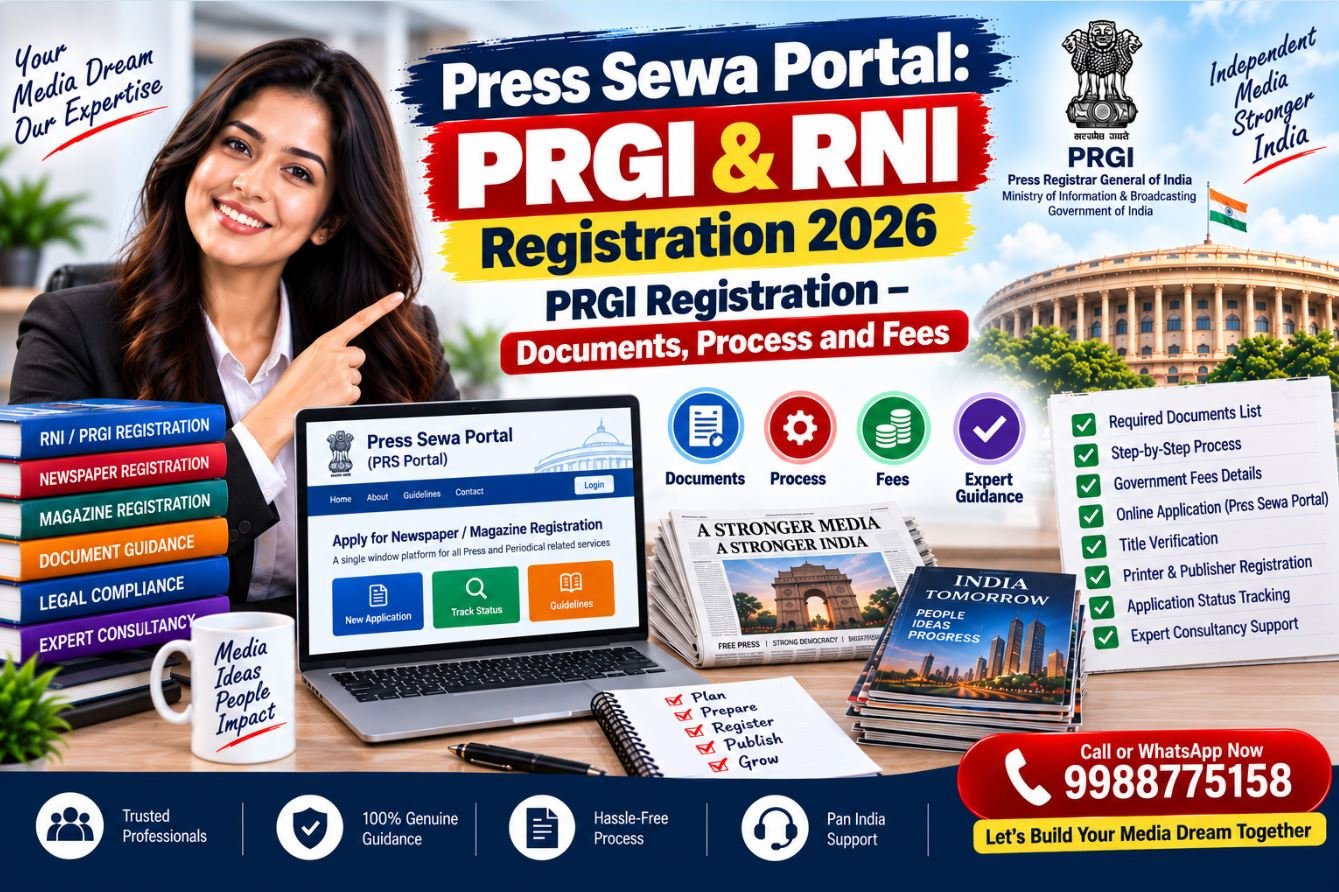
The Press Sewa Portal is the official digital platform launched by the Press Registrar General of India (PRGI) under the Ministry of Information and Broadcasting (MIB) . It serves as a one-stop solution for all registration and compliance needs of publishers across India.
Key Features of the Press Sewa Portal:
-
Aadhaar-based e-Sign: Publishers can file online applications using Aadhaar-based e-signatures .
-
Real-Time Tracking: A seamless dashboard allows publishers to track their application status in real-time .
-
Paperless Process: The entire registration process, from title verification to certificate download, is paperless .
-
Direct Payment Gateway: Fees can be paid online directly through the portal .
-
QR Code Certificates: Digital certificates can be downloaded instantly via QR code .
-
AI Chatbot: An AI-based chatbot is available to assist publishers in their preferred language .
Why Do You Need PRGI/RNI Registration?
A PRGI Certificate (formerly RNI Certificate) is the legal proof that your publication is registered with the Government of India. Without it, you cannot:
-
Protect Your Title: You cannot claim legal ownership of your publication’s name. Someone else could steal it.
-
Get Government Advertisements: You cannot apply for DAVP (now CBC – Central Bureau of Communication) empanelment, which is a major revenue source for newspapers .
-
Get Press Accreditation: Your journalists cannot get official Press Cards, railway passes, or other government facilities.
-
Claim Legal Publisher Status: You are not recognized as a registered publisher under the PRP Act.
PRGI Registration Process 2026: Step-by-Step Guide
The new process is faster but strictly technical. One mistake in the PRGI application form can cause rejection . Here is the complete step-by-step process:
Step 1: Profile Creation on the Press Sewa Portal
Visit the official Press Sewa Portal and create a profile as the Owner of the publication. You will need a valid Aadhaar Card, PAN Card, and an active mobile number and email address .
Step 2: RNI/PRGI Title Verification (The Most Critical Step)
This is where 60% of applications fail . You must submit 5 priority options for your newspaper or magazine name. The PRGI algorithm checks for:
-
Phonetic Similarity: “News Time” is too similar to “News Times” .
-
Reserved Words: Words like Police, Crime, Corruption, Army, Government, India often trigger flags .
-
Language Conflicts: A name registered in one language may block your title in another .
Pro Tip: Avoid generic names like “India News” or “City Times.” Be creative and unique .
Step 3: Filing the Intimation
Instead of the old “Title Verification Letter,” you now file an online Intimation. You will select your Periodicity (Daily, Weekly, Monthly), Language (Hindi, English, Regional), and the State and District of publication .
Step 4: Form-I Declaration (DM/SDM)
This is the legal declaration under the PRP Act. The Publisher and the Printer must sign this form. While the process is initiated online, in some districts, a physical visit to the local authority (DM/SDM) may still be required for final approval .
Step 5: Printing the First Issue
Once approved, you have 45 days (for dailies) or 90 days (for periodicals) to print your first issue . You must upload the First Issue Sample PDF to the portal.
Critical: Ensure the Imprint Line at the bottom of your publication is 100% accurate. It must contain: “Printed by [Printer Name], Published by [Publisher Name] on behalf of [Owner Name] and Printed at [Press Address] and Published at [Office Address]. Editor: [Editor Name].” A single missing comma can cause rejection .
Step 6: Final PRGI Certificate
After the PRGI verifies your uploaded copy and the Printer’s Certificate (Form-IV), you can download your Certificate of Registration (CoR) directly from the portal .
Documents Required for PRGI Registration 2026
To avoid rejection, keep this PRGI documents checklist ready:
Identity Proof
-
Aadhaar Card of the Publisher and Owner
-
PAN Card of the Publisher and Owner
-
Passport-size photographs
Business/Entity Proof
-
GST Certificate (if applicable)
-
MSME/Udyam Certificate or Shop Act License (optional but recommended)
-
For companies: Certificate of Incorporation, CIN, Board Resolution
-
For partnership firms: Partnership Deed
Premises Proof
-
Rent Agreement or Electricity Bill of the publication office address
Printer Documents
-
Printer Certificate Form-IV: Issued by the owner of the printing press
-
Printing Press Agreement: A legally sound agreement with the press owner
-
Press Keeper’s License: The commercial printer must have a valid license uploaded in their profile
Legal Affidavit
-
Eligibility and Content Affidavit: Declaring that your content qualifies as public news under the PRP Act. Use only the current format from prgi.gov.in .
-
RNI Affidavit Format: Declaring no criminal background
PRGI Registration Fees 2026: Complete Cost Breakdown
One of the most practical questions is about the total investment required for PRGI registration. Here is the complete transparent breakdown for 2026:
1. Mandatory Government Fee: ₹1,000 (Fixed)
-
What it covers: Processing charge for your application on the Press Sewa Portal .
-
When to pay: At the time of final online submission.
-
Payment method: Online payment through the portal (Net Banking, Credit/Debit Card, UPI).
-
Important: This fee is non-refundable if your application is rejected .
2. Professional Consultation & Service Fees: ₹15,000 – ₹35,000
This is where costs vary significantly based on the complexity of your case and level of support needed .
| Service Level | Professional Fee | What’s Included |
|---|---|---|
| Basic Package | ₹15,000 – ₹20,000 | Document preparation, Title affidavit drafting, Form filling assistance |
| Standard Package | ₹20,000 – ₹28,000 | Complete document preparation, Title availability research, End-to-end filing, DM office follow-up |
| Premium Package | ₹28,000 – ₹35,000 | Advanced title strategy (5+ options), Priority processing, Dedicated relationship manager, Post-registration guidance |
3. Incidental Expenses: ₹500 – ₹2,000
-
Notary charges: For affidavit stamping (varies by state)
-
Courier/transport: For document transfers if needed
-
Miscellaneous: Printing, scanning, etc.
Total Estimated Cost Table
| Service Level | Govt Fee | Professional Fee | Incidental | Total Estimated |
|---|---|---|---|---|
| Basic | ₹1,000 | ₹15,000 – ₹20,000 | ₹500 – ₹1,000 | ₹16,500 – ₹22,000 |
| Standard | ₹1,000 | ₹20,000 – ₹28,000 | ₹1,000 – ₹1,500 | ₹22,000 – ₹30,500 |
| Premium | ₹1,000 | ₹28,000 – ₹35,000 | ₹1,500 – ₹2,000 | ₹30,500 – ₹38,000 |
Source:
PRGI Registration Timeline 2026
| Stage | Estimated Time |
|---|---|
| Profile Creation & Title Submission | 1-2 days |
| Title Verification | 15-30 days |
| Form-I Declaration & DM Processing | 7-15 days |
| First Issue Printing | Within 45/90 days |
| Final Verification & Certificate | 15-30 days |
| Total Estimated Time | 2 to 4 months |
If there is an objection or rejection, the timeline can extend to 6 months or even a year.
Why Hire a PRGI Registration Consultant?
While the process is online, it is highly technical. Here is why smart publishers hire a professional:
-
Guaranteed Title Approval: Consultants use advanced search techniques to find names that won’t be rejected .
-
Error-Free Documentation: They draft the perfect Legal Affidavit for Publication and agreements .
-
Time Saving: They handle PRGI portal filing assistance and follow-ups so you can focus on journalism .
-
Glitch Resolution: The new portal often has technical issues; experienced agents know how to navigate them .
-
Local Liaison: They coordinate with DM/SDM offices across districts for faster processing .
Common Reasons for PRGI Application Rejection
-
Title Rejection: Similar phonetic name, reserved words, or trademark conflict .
-
Document Errors: Wrong affidavit format, incomplete Form-I declaration, missing printer certificate .
-
Incorrect Imprint Line: Even a single missing comma or mismatch can cause rejection .
-
Technical Issues: Aadhaar/mobile linking errors, file upload failures on the portal .
-
Outdated Formats: Using old affidavit formats from before the PRP Act 2023 .
Frequently Asked Questions (FAQs)
Q1: What is the difference between RNI and PRGI?
A: RNI (Registrar of Newspapers for India) was the old authority. Under the PRP Act 2023, it was renamed PRGI (Press Registrar General of India). The registration process is now completely digital via the Press Sewa Portal .
Q2: What is the PRGI registration fee in 2026?
A: The mandatory government fee is ₹1,000 (non-refundable). Professional consultancy charges range from ₹15,000 to ₹35,000 depending on the package you choose .
Q3: How long does PRGI registration take in 2026?
A: If all documents are correct, the process typically takes 2 to 4 months from title submission to final certificate. Objections can extend this to 6+ months.
Q4: Can I register my newspaper without owning a printing press?
A: Yes, you can. You must have a Keeper of the Press Agreement with a registered commercial printer who has an active profile on the Press Sewa Portal .
Q5: What documents are required for PRGI registration?
A: Key documents include: Aadhaar Card, PAN Card, address proof, Eligibility and Content Affidavit, printer details, and Form-I Declaration. For companies, a Certificate of Incorporation is also required .
Q6: Can I do PRGI registration myself without a consultant?
A: Yes, but the risk of rejection is very high. Technical errors in the application, wrong affidavit formats, or title conflicts can delay your project by months. A consultant ensures first-time-right filing .
Q7: What is the Imprint Line and why is it important?
A: The Imprint Line is the footer on the last page of your publication that legally declares the Printer, Publisher, Owner, and Editor’s details. Under the PRP Act, this must follow a strict format. Any deviation can cause your final certificate to be rejected .
Q8: What happens if I don’t file the Annual Statement?
A: Every registered publisher must file an Annual Statement on the PRGI portal every financial year. Failure to do so can mark your title as “Defunct,” and you may lose your brand name permanently .
Q9: Is RNI registration required for a digital-only news portal?
A: Purely digital news portals typically follow IT Rules 2021. However, many serious publishers opt for RNI/PRGI registration for their e-paper versions to establish credibility and secure their brand name legally .
Q10: How can I check my RNI/PRGI application status?
A: You can track your application in real-time through the dashboard on the Press Sewa Portal. You can also use the RNI status check online feature .
Conclusion: Start Your Publication Legally with PRGI Registration
Getting your PRGI/RNI registration is the first and most critical step toward becoming a legally recognized publisher in India. While the Press Sewa Portal has made the process digital and transparent, the technicalities and documentation requirements are strict. A single error can cost you months of delay.
Whether you are launching a daily newspaper, a monthly magazine, or a regional language periodical, ensuring 100% compliant documentation is the key to fast approval. Don’t let technical glitches or title rejections derail your publishing dream.
Ready to start your publication? Get expert guidance on PRGI registration, title verification, printer agreements, and end-to-end documentation from India’s trusted consultancy.
🌐 Website: prgiregistration.com
📞 Call/WhatsApp: 9988775158
Important: This article provides general educational information and private consultancy guidance. Official requirements, portal steps, fees and decisions should be verified from current PRGI and Press Sewa sources.