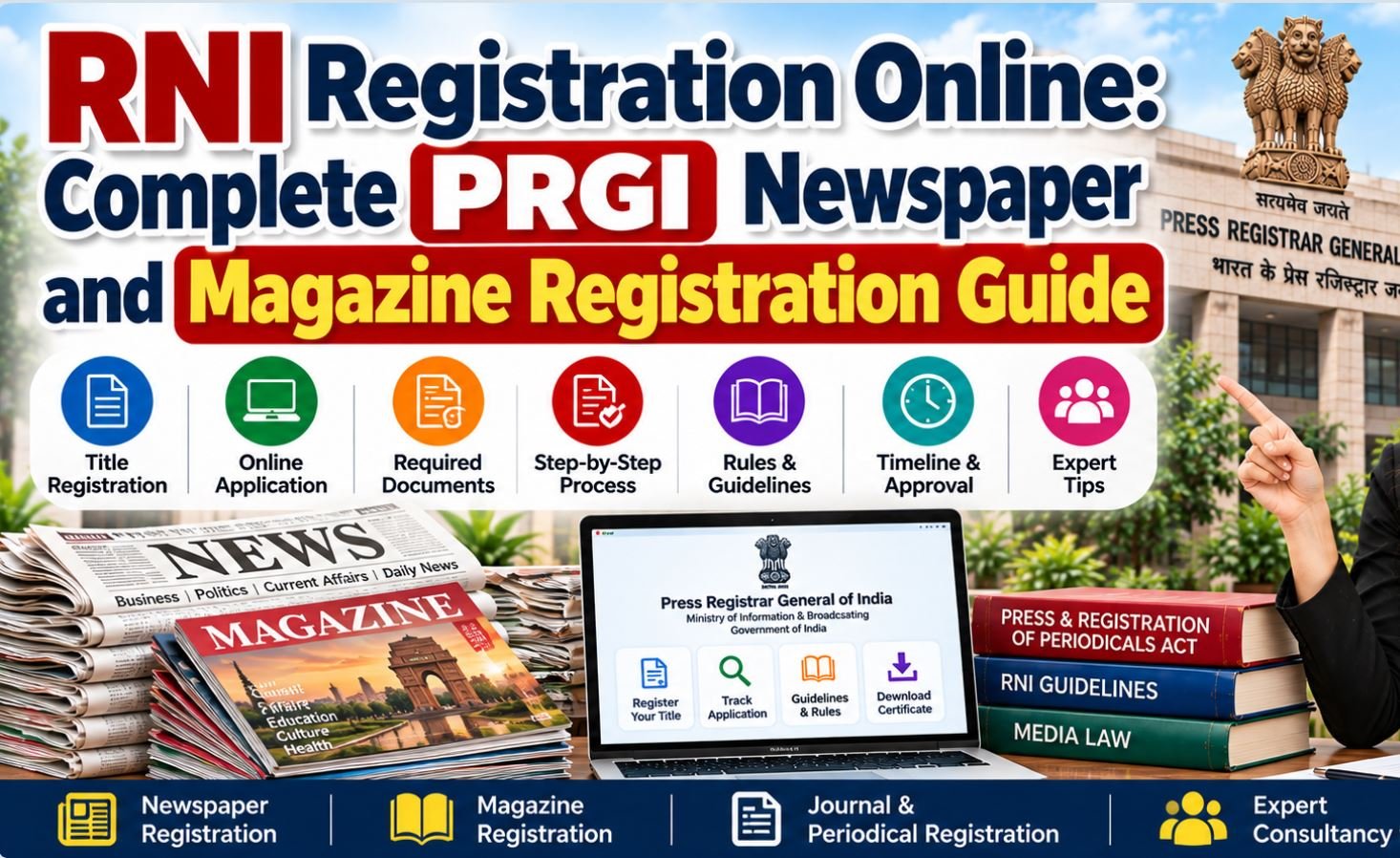
What Is RNI Registration?
RNI registration is the familiar legacy phrase used for the registration of newspapers and other eligible periodicals in India. For decades, publishers knew the relevant office as the Registrar of Newspapers for India. Under the present framework, the authority is called the Press Registrar General of India, commonly abbreviated as PRGI.
Even after the terminology changed, publishers continued to search for RNI registration online, RNI title verification, RNI registration documents, RNI registration fees, RNI registration consultant India and similar phrases. These searches should now be understood in the context of the current PRGI system and the Press and Registration of Periodicals Act, 2023.
Registration is not simply the purchase of a “newspaper licence.” It is a regulated process in which the proposed publication, its title, language, periodicity, place of publication, ownership, publisher and printer particulars are submitted through the official online workflow and examined by the competent authority.
A successful submission begins long before the final application button is pressed. The applicant needs a clear publication plan, strong title options, accurate records and a consistent understanding of the roles involved. A mismatch between the title, language, address, publisher or printing-press particulars can create avoidable questions during scrutiny.
RNI vs PRGI: What Is the Difference?
RNI is the older name and popular search term. PRGI is the current authority terminology. This distinction is important because many older blogs, videos and document samples describe processes that existed under the previous law. Publishers should not assume that an old RNI checklist, declaration form or physical submission route is still the current process.
The Press and Registration of Periodicals Act, 2023 came into force on 1 March 2024. The current process is designed around online applications through the Press Sewa Portal. The portal covers services such as registration of new periodicals, revision of existing registration, ownership transfer and other related processes.
In practical SEO language, phrases such as PRGI RNI registration, RNI PRGI registration services, PRGI registration process and RNI registration process may bring users to the same subject. A reliable guide should acknowledge the older keyword while explaining the present legal and procedural terminology.
Who May Need PRGI Periodical Registration?
The current law concerns eligible periodicals, including newspapers, that are published and printed at regular intervals and contain public news or comments on public news. A project should be evaluated according to its real publication model—not merely the words “news,” “journal” or “magazine” in its name.
This guide may be useful for publishers planning:
- a daily newspaper;
- a weekly or fortnightly newspaper;
- a monthly news magazine;
- a regional-language periodical;
- a trade or industry periodical containing relevant public news;
- a multilingual publication;
- a local, district, state or national periodical.
Not every publication called a journal falls within the same registration framework. Books and scientific, technical or academic journals are treated differently under the current Act. Publishers should verify eligibility before spending money on branding, printing arrangements or consultancy.
Does an online news portal require RNI registration?
A digital-only news website and an eligible printed periodical are not automatically the same. People often search for online news portal registration, news website registration India or web news portal registration, but the appropriate compliance route depends on the actual business and publishing model. Do not advertise a private website registration as an official PRGI certificate unless it genuinely falls within and completes the applicable official process.
Publication Title Planning and RNI Title Verification
A publication title is more than a marketing name. It becomes a central part of the official application and should be chosen with care. The official process asks the owner to provide proposed titles in priority order. Preparing only one weak or highly generic name can reduce the applicant’s flexibility.
A responsible newspaper title search should consider the complete proposed name, not merely one word. Similarity can arise from spelling, pronunciation, word order, meaning or the addition of a generic term. Adding words such as “daily,” “news,” “times,” “today,” “express” or a place name does not automatically make a proposed title distinctive.
How to choose a stronger newspaper name
Begin with the publication’s identity. Consider its audience, language, editorial focus and geographic positioning. Build multiple title combinations that remain readable and brandable while avoiding confusing similarity with existing publications.
Before official filing, a private RNI title check online or PRGI title search may help identify preliminary risks. Our AI PRGI Title Checker allows a customer to analyse one proposed title or compare five options. It may display preliminary chance, RISK signals, similar-title indicators and alternative suggestions.
The result must be interpreted correctly. Private RNI PRGI title verification is a planning aid, not an official title reservation, allotment or approval. Only the competent authority can make the final decision.
Title-planning checklist
- Prepare five meaningful proposed titles in priority order.
- Check spelling carefully in the chosen language and script.
- Avoid a title that closely resembles a known publication.
- Do not depend solely on a one-letter change.
- Keep backup titles genuinely different from one another.
- Use the same title spelling consistently throughout the application.
- Treat private software scores as preliminary information only.
RNI PRGI Registration Process Step by Step
Users frequently search for How to apply for RNI PRGI registration or RNI PRGI registration process step by step. The following roadmap explains the preparation in practical language. The live portal and current official instructions remain the final source.
Step 1: Define the publication
Decide the publication category, language, periodicity and proposed place of publication. Clarify whether it will be daily, weekly, fortnightly, monthly or another eligible frequency. A vague plan can create contradictions later.
Step 2: Confirm the ownership structure
Identify whether the owner is an individual or an entity such as a company, society or trust. The information and supporting records should correspond to the actual owner. Do not use another person’s identity merely to simplify the application.
Step 3: Create the owner profile
The owner begins the official online process by signing up and creating the relevant profile. Details should be entered exactly and supported by current records. Email and mobile access should remain under the applicant’s control.
Step 4: Prepare five proposed titles
The owner should submit five proposed titles in order of priority. The options should be distinctive, correctly spelled and suitable for the chosen language. Use preliminary research to avoid submitting five near-identical alternatives.
Step 5: Organise publisher and printer information
Prepare the publisher’s particulars and the applicable printer/printing-press information. Every role should be understood correctly. The same person may not automatically be assumed to occupy every role without checking the current requirements.
Step 6: Review documents and consistency
Compare names, addresses, mobile numbers, email addresses, entity details and publication particulars. A document may be genuine but still create a problem if the application contains a different spelling or outdated address.
Step 7: Submit through Press Sewa Portal
Use the genuine official portal, choose the correct service and review each field before submission. Retain the acknowledgement, reference number and official transaction record where applicable.
Step 8: Monitor scrutiny and communication
Check the portal dashboard, registered email and mobile. The application status may be updated through the official system. If a clarification is requested, note the deadline and respond to the actual observation.
Step 9: Follow the official decision
Submission does not itself create an approval right. Title allotment and registration depend on official scrutiny under the applicable framework. No private agent can lawfully replace this decision.
Step 10: Maintain post-registration compliance
After registration, keep registered particulars accurate and follow applicable publication and annual-statement responsibilities. Use the prescribed online service for revisions, ownership transfer or other changes.
RNI Registration Documents and Information Checklist
The exact PRGI registration documents depend on the applicant type and selected service. A fixed list copied from another application may be incomplete or irrelevant. The following categories help publishers prepare without presenting an outdated list as universal.
Owner-related information
Keep the owner’s full name, current address, mobile number, email address, photograph and identity particulars ready as requested in the live workflow. If the owner is an entity, keep its valid registration and authorisation records available.
Entity and authorisation records
A company, society, trust or other organisation may need records showing its legal existence and the authority of the person acting for it. Ensure that resolutions or authority letters match the applicant and intended publication.
Publisher information
Prepare the publisher’s correct identity, contact details and address. If consent or authorisation is applicable, it should be clear and consistent with the application.
Printer and printing-press information
Keep the printer’s particulars and relevant press information ready. Do not rely on a random printing press agreement format downloaded from an unverified website. Use the current format or information requirement that actually applies to the selected service.
Publication particulars
Confirm the five title options, publication language, periodicity, category and proposed place. These details should remain consistent across every relevant profile and stage.
Portal-requested attachments
Upload clear, readable files in the required format and size. Avoid cropped scans, expired records, password-protected PDFs or documents in which important particulars are hidden.
Records to retain after submission
Save the acknowledgement, application number, payment record, official emails and copies of any query response. These records are important for tracking and future revisions.
Owner, Publisher and Printer Profiles Explained
One of the most common sources of confusion in newspaper registration is the difference between owner, publisher, printer and editor. These terms describe different responsibilities. The person or organisation funding or owning the publication is not automatically the same as the person responsible for publishing or printing it.
Owner profile
The owner initiates the publication-registration journey and provides proposed titles. Ownership particulars should correspond to real legal and operational control. The owner’s registered contact details should remain accessible throughout the process.
Publisher profile
The publisher is responsible for publishing the periodical. The publisher’s name, address and authorisation should be entered consistently. If the publisher changes later, use the appropriate official online service rather than merely editing a printed masthead.
Printer and printing press
The printer and the printing press are relevant to the production of the periodical. The current Press Sewa Portal supports online printer-related processes. Verify that the press details are accurate and that the printer understands the request or intimation relevant to the publication.
Editor information
The editor is associated with editorial responsibility. A later change in editor should be handled according to current compliance requirements and reflected correctly in publication records where applicable.
Press Sewa Portal Registration and Application Filing
The Press Sewa Portal is the official online platform used for receiving and processing periodical-registration applications and related services. The current system is designed for online, paperless processing and covers more than just new registration.
Users searching for PRGI portal login, PRGI portal registration, Press Sewa Portal application or Press Sewa Portal support should confirm that they are visiting the genuine government domain. Look-alike websites and private consultancy pages must not be confused with the official portal.
Basic portal-safety practices
- Keep the registered email and mobile accessible.
- Do not share OTPs with unknown people.
- Use a strong, unique password.
- Verify the service category before payment or submission.
- Download acknowledgements and official receipts.
- Check the dashboard instead of relying only on verbal updates.
A private consultant may assist with understanding fields, preparing information and reviewing visible inconsistencies. The applicant should still understand what is being submitted and keep control of the account.
RNI Registration Fees and Processing Timeline
Publishers often ask, “How much does RNI registration cost?” There are two different concepts: any applicable official charge and the separate fee charged by a private professional for guidance or documentation support.
Government or portal charges
Verify the current official charge in the live Press Sewa Portal workflow. Do not rely on an old screenshot, social-media message or third-party rate card. Save the official payment receipt where a charge applies.
Private consultancy fee
A private RNI registration consultant may charge for title research, profile guidance, document review, portal assistance or query-response preparation. This professional fee is not a government fee and should be disclosed separately.
How long does registration take?
There is no single guaranteed RNI registration timeline. Processing can depend on the proposed titles, accuracy of profiles, completeness of documents, official workload, technical issues and the speed with which the applicant answers a query.
A promise such as “guaranteed certificate in a fixed number of days” should be treated cautiously. A consultant can improve preparation but cannot control the competent authority’s decision or workload.
PRGI Query Response, Corrections and Registration Revisions
An official observation does not always mean that an application is permanently rejected. It may seek clarification, a corrected detail or a supporting record. The correct response depends on the exact wording of the query.
How to respond to a query
- Read the complete observation.
- Note the response deadline.
- Compare the query with the original submission.
- Prepare only the requested clarification or evidence.
- Maintain consistency with owner, publisher, printer and publication details.
- Keep a copy of the response and attachment.
A structured PRGI query response should be factual and concise. Do not upload unrelated records merely to make the response appear larger.
Changes after registration
Publishers may later need a revision of the registration, transfer of ownership, change of publisher or another update. The Press Sewa Portal provides online services for relevant changes. Use the correct service and verify the required records instead of assuming that a letter or email alone will change official data.
Searches such as RNI ownership change, RNI publisher change, RNI editor change, RNI periodicity change and RNI duplicate certificate should be matched to the present PRGI service terminology.
How to Choose an RNI Registration Consultant in India
A publisher may search for an RNI PRGI registration consultant, PRGI registration consultant India, RNI registration agent, newspaper registration consultant or magazine registration consultant. The label matters less than the quality, transparency and scope of the actual service.
A responsible consultant should
- explain the current PRGI process rather than repeating an outdated RNI workflow;
- tell the applicant which information is still missing;
- review title options without presenting a private score as official approval;
- check consistency across names, addresses and publication particulars;
- separate professional fees from official charges;
- protect applicant credentials and personal information;
- avoid guarantees about allotment, certificate or timeline.
Warning signs
- “100% guaranteed title approval.”
- “We can influence the government decision.”
- “Give us permanent access to your OTP and email.”
- “No documents are needed.”
- “Government fee and consultancy fee are the same.”
- “Certificate is guaranteed within a fixed period.”
PRGIRegistration.com provides independent private assistance for title planning, document readiness and process understanding. It is not a government portal and cannot guarantee an official outcome.
RNI/PRGI Registration Guidance Across India
Because the application process is online, publishers frequently seek remote guidance from different states and cities. Location searches include RNI registration Delhi, RNI registration Noida, PRGI registration Uttar Pradesh, RNI registration Bihar, PRGI consultant Rajasthan, RNI registration Mumbai, PRGI registration Pune, RNI registration Ahmedabad, RNI registration Kolkata, RNI registration Chennai, RNI registration Bangalore and RNI registration Hyderabad.
Online private consultation may also help publishers in Lucknow, Ghaziabad, Gurugram, Faridabad, Jaipur, Bhopal, Indore, Raipur, Patna, Ranchi, Chandigarh, Dehradun, Jammu, Srinagar, Surat, Vadodara, Rajkot, Nagpur, Bhubaneswar, Guwahati, Coimbatore, Madurai, Kochi, Vijayawada and other locations.
GEO relevance should not be created only by repeating city names. A useful page should explain whether assistance is online, what services are offered, which languages are supported and that final decisions remain with the central competent authority.
RNI Registration in Hindi: Important Search Questions
Hindi-speaking publishers often search for RNI रजिस्ट्रेशन कैसे करें, PRGI रजिस्ट्रेशन कैसे करें, अखबार का रजिस्ट्रेशन कैसे करें, समाचार पत्र रजिस्ट्रेशन, पत्रिका रजिस्ट्रेशन, अखबार का नाम रजिस्टर कैसे करें, RNI टाइटल वेरिफिकेशन, PRGI रजिस्ट्रेशन फीस and Press Sewa Portal पर आवेदन.
इन सभी प्रश्नों का मूल उत्तर यह है कि वर्तमान प्रक्रिया PRGI और Press Sewa Portal से जुड़ी है। आवेदन से पहले publication category, language, periodicity, place, owner, publisher, printer और पाँच proposed titles की तैयारी करनी चाहिए। किसी private consultant या software report को official approval नहीं समझना चाहिए।
Frequently Asked Questions About RNI Registration
What is RNI registration online?
RNI registration online is the commonly searched older phrase for the present online registration process concerning eligible newspapers and periodicals. The current authority is PRGI, and applications are processed through the Press Sewa Portal.
What is the difference between RNI and PRGI?
RNI is the former authority name and remains a popular keyword. PRGI, the Press Registrar General of India, is the current authority under the Press and Registration of Periodicals Act, 2023.
Where is the current registration application submitted?
The current application is submitted online through the official Press Sewa Portal. Applicants should verify the genuine government domain before creating an account or making a payment.
How many proposed titles should an owner prepare?
The current process asks the owner to provide five proposed titles in order of priority. The options should be distinctive and not merely small spelling variations of the same name.
Can I check RNI title availability online?
A private title checker can provide preliminary similarity information. It is useful for planning, but it does not reserve or officially approve a title.
Which documents are required for PRGI registration?
The exact requirements depend on applicant type and service. Common preparation categories include owner, entity, publisher, printer, address and publication details, plus current portal-requested supporting files.
What is the government fee for RNI registration?
Verify current official charges in the live Press Sewa Portal workflow. Private consultancy fees are separate and should be clearly identified.
How long does PRGI registration take?
No universal timeline applies. Title scrutiny, documents, profiles, official workload, technical issues and query responses can affect processing time.
Can a consultant guarantee title approval?
No. A consultant may assist with planning and documentation, but title allotment and registration are decided only by the competent authority.
Are old Form-I and Form-IV procedures still current?
Do not assume so. Many online articles describe the former process. Verify every legacy form against the current PRP Act, rules and live PRGI instructions before using it.
Can a magazine be registered under PRGI?
An eligible periodical may follow the applicable framework. The real content, periodicity and publication model should be checked; not every publication called a magazine or journal is treated identically.
Does a news website automatically require PRGI registration?
No automatic conclusion should be made. A digital-only website and a printed periodical are different publication models. Obtain advice suited to the actual activity.
What happens when PRGI raises a query?
The applicant should read the observation, note the deadline and submit the specific clarification, correction or supporting record requested through the appropriate official route.
How can the application status be checked?
Use the official portal dashboard and the registered communication channels. Keep the application acknowledgement and reference information secure.
Can registration details be changed later?
Relevant online services may be available for revision, ownership transfer and other updates. Use the correct current service and supporting records.
What can a private registration consultant do?
A private consultant can explain the workflow, organise information, review visible inconsistencies and assist with query-response preparation. The consultant cannot issue an official certificate or guarantee approval.
Final Checklist Before You Apply
- Confirm that the publication appears eligible under the current framework.
- Decide language, periodicity and place of publication.
- Prepare five distinctive proposed titles.
- Check the exact spelling and script of every title.
- Prepare accurate owner and entity records.
- Confirm publisher and printer particulars.
- Review every name, address, email and mobile number for consistency.
- Use the genuine Press Sewa Portal.
- Retain control of passwords and OTPs.
- Save acknowledgements and payment records.
- Monitor official communication after submission.
- Never rely on a private guarantee of approval.
Need Help Planning Your Newspaper or Magazine Registration?
Prepare your proposed titles, publication language, periodicity, state, place of publication and ownership type before requesting private guidance. For preliminary title screening, use the AI PRGI Title Checker. For independent consultancy information, visit PRGIRegistration.com.
Important: This article provides general educational information and private consultancy guidance. Official requirements, portal steps, fees and decisions should be verified from current PRGI and Press Sewa sources.